The most expensive thing in a go-to-market strategy is not ads. It is ambiguity.
I have watched smart teams spend weeks arguing about channels when the real problem was simpler and more embarrassing: they did not know who they were speaking to, what they wanted that person to feel, or why anyone would care on a Tuesday afternoon. So they made slides. Then they made more slides. Then they launched something that sounded polished and landed like wallpaper.
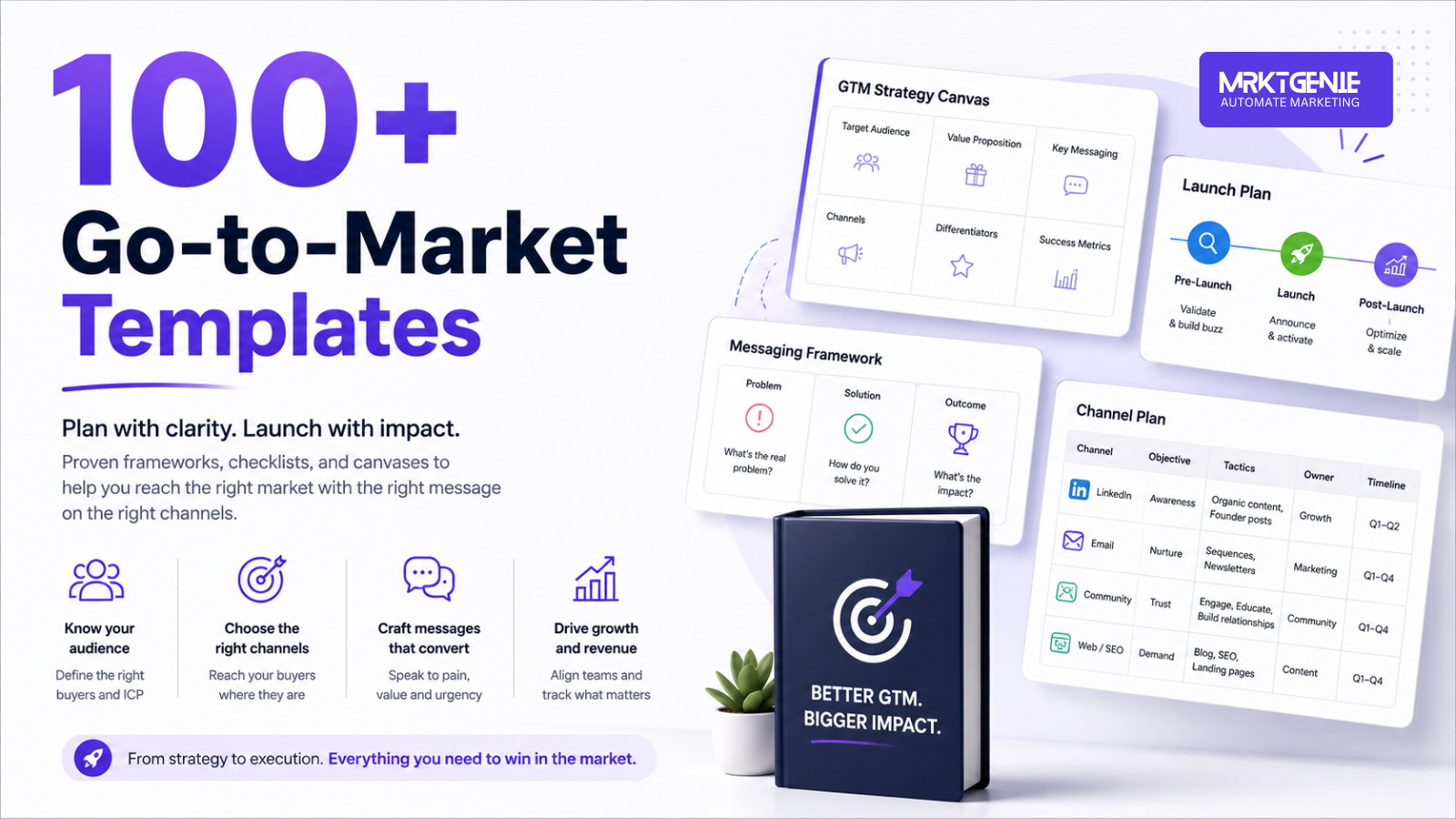
That is why 100+ go-to-market templates can be useful—if they are not treated like decoration. The right template does not make you “more strategic". It forces decisions. It tells you what to say, who to say it to, and where the message should actually travel. And when planning is messy, templates are often the fastest way to turn fog into movement.
Who this is really for
This is for the founder staring at a blank launch doc. The product marketer being asked to “own GTM” without being given a budget, a target customer, or a coherent story. The growth lead who knows the team needs a launch plan, a channel plan, and a messaging plan but keeps getting asked for “just one more version".
The problem is not a lack of ideas. It is too many half-ideas and not enough structure. One person wants LinkedIn. Another wants an email. Sales wants a one-pager. Leadership wants “a narrative". Meanwhile, the actual customer is still unclear on what the product does, why it matters, and why now.
If that sounds familiar, you are not behind. You are normal.
The real problem: GTM breaks when the team plans from the inside out
Most go-to-market plans fail before they start because they are built around the company’s preferences, not the buyer’s attention.
A founder says, “Let’s do a webinar.” A marketer says, “We need a launch post.” Sales says, “Can I get a deck?” Everyone is busy. Nobody is aligned. The result is a pile of assets with no shared logic.
Good GTM planning starts with three questions that sound simple but are rarely answered well:
- Audience: Who is this for, specifically?
- Channels: Where does that person already pay attention?
- Messaging: What makes them stop, trust, and act?
That is the whole game. Everything else is execution.
Audience: the template most teams skip too quickly
Teams love to say, "Our audience is SMBs” or "We sell to operations teams.” That is not an audience. That is a tax category.
The best audience template forces you to get uncomfortably specific. Not “marketing teams". Try “marketing managers at 20-100 person B2B SaaS companies who are responsible for pipeline but are tired of creating content that never turns into meetings.” Now you are close enough to write something that feels true.
I once saw a startup prepare a launch aimed at “HR leaders". The campaign underperformed. When they reworked the audience template, they found the real buyer was not HR leadership at all—it was the director who was carrying implementation risk and hated adding another tool. The product did not change. The audience did. The response did too.
That is the first hidden value of templates: they expose lazy assumptions.
Questions a strong audience template should answer
- Who feels the pain most sharply?
- Who has budget authority?
- Who influences the decision?
- What event makes the problem urgent now?
- What objection will appear in the first five minutes?
If you want a deeper point of view on this, why startups should build audiences before products is worth reading. The short version: distribution gets easier when you know who is already listening.
Channels: stop asking where you can post; start asking where buyers already believe things
One of the most common GTM mistakes is channel selection by habit. A team chooses LinkedIn because “everyone is there.” Or email because “we already have a list.” Or paid because “it scales".
But channels are not equal. They do different psychological work.
Some channels create awareness. Some create trust. Some create urgency. Some create proof. A launch post may introduce you. A community post may validate you. A sales sequence may close you. If you expect one channel to do all four, you usually end up disappointed and overworked.
Think of channels like rooms in a house. You would not cook in the bedroom and sleep in the kitchen. Yet that is exactly how many GTM plans behave: one message, everywhere, with no regard for context.
A customer reading a polished website hero is in a different state of mind than a buyer reading a peer recommendation in a Slack group. Same product. Different mood. Different trust threshold. Different next step.
A practical way to choose channels
- Discovery channels: where new people first notice the problem
- Credibility channels: where they verify you are real
- Conversion channels: where they take action
For many startups, the mistake is spending too much time on discovery and too little on credibility. If people hear about you but cannot quickly trust you, the funnel leaks.
That is why founder-led visibility, community participation, and proof-based content often outperform flashy campaigns early on. If you want a useful companion piece, the best growth channel might be one you’re ignoring. It's a good reminder that the obvious channel is rarely the cheapest one.
Messaging: the part everyone thinks they have, until they test it
Messaging is where optimism goes to die.
Inside the company, everything sounds clear. Outside the company, people squint at your homepage and ask, “Okay, but what is this?” That gap is not a copywriting issue. It is a thinking issue.
Strong messaging does three things fast:
- names the problem better than the buyer can
- shows why the current workaround is expensive
- makes the next step feel safe
Weak messaging talks about features. Strong messaging talks about relief.
For example, “AI-powered workflow automation” is a sentence. “Stop copying the same customer data into three tools every time a deal closes” is a reason to care. One sounds like a category. The other sounds like someone watched you suffer.
I once worked with a team that kept describing their product as “an all-in-one platform". Conversion was flat. When they changed the message to a more specific promise—cutting a painful manual process in half—the response changed immediately. Same software. Different story. Better economics.
If your team keeps producing generic claims, this breakdown of why users ignore generic startup claims explains why those phrases die on contact with real buyers.
Why templates work: they reduce the cost of disagreement
Most teams do not lack intelligence. They lack a shared object to argue with.
A good GTM template gives people something concrete to edit. Without it, every conversation drifts into opinion. With it, the debate becomes useful:
- Is this the right buyer?
- Is this the right pain point?
- Does this channel match the buyer’s behaviour?
- Does this headline earn attention?
That is progress.
Templates are not the strategy. They are the scaffold that lets strategy become visible. And when you have 100+ of them, you are not collecting busywork. You are building a library of decision shortcuts for launches, campaigns, segments, and experiments.
That matters because the real bottleneck in GTM is not writing. It is iteration speed.
What the best GTM templates usually cover
If you are building or choosing a template set, the most useful ones tend to cluster around a few jobs:
- Audience templates: persona, ICP, buying committee, pain mapping
- Channel templates: launch plan, email sequence, social campaign, community post, partner outreach
- Messaging templates: value proposition, positioning statement, headline bank, objection handling, proof points
- Execution templates: campaign brief, launch checklist, content calendar, experiment log, post-launch review
Notice what is missing: fluff. No one needs another “brand manifesto” that sounds wise and changes nothing. You need working documents that help people decide what to do next.
If you have ever tried to turn a launch into a content system, this feature launch playbook shows how a single release can become SEO, activation, and distribution material without turning into a month-long production.
Three GTM scenarios that templates make easier
1. The founder who needs a launch plan in 48 hours
There is always a founder who says, “We are launching next week. Can we just do something?”
Yes. But only if “something” has structure. A launch template helps you answer the only questions that matter under pressure: who is it for, what is the message, and where will it live?
Without that, you get a launch that feels energetic and performs like a shrug.
2. The marketer who is told to “make it convert”
This usually means the message is vague, the audience is broad, and the channel mix is inherited from someone else’s opinion. A messaging template helps the marketer stop guessing. A channel template helps them stop overproducing. An audience template helps them stop writing to everyone and therefore no one.
3. The startup that has traffic but no pipeline
This one hurts because it looks like success from far away. People are clicking. People are reading. People are not buying.
Usually the issue is not volume. It is a mismatch. The audience is broad, the channel is top-of-funnel, and the message never earns the next step. Templates can reveal the leak faster than another brainstorm ever will.
For a deeper look at that gap, how to create startup content that actually brings leads is a practical companion to this article.
A simple way to use 100+ GTM templates without getting lost
More templates do not automatically mean better planning. In fact, too many templates can become a hiding place for indecision.
So use them in this order:
- Pick the audience template first.
- Use it to define the buyer and the pain.
- Choose the channel template that matches the buyer’s attention pattern.
- Write the messaging template last, after the first three choices are clear.
That sequence matters. Most teams do the opposite. They write the message first, then try to force the audience and channel to obey it. That is backward.
Think of it like building a bridge. You do not start with paint colours. You start with the load-bearing parts.
The hidden benefit: templates make your team less emotional and more precise
People talk about GTM as if it were a creative problem. It is partly creative. But it is also a stress problem.
When launch pressure rises, teams become reactive. They chase opinions. They over-edit headlines. They change the target audience midstream. They confuse motion with progress.
Templates calm the room.
They create a shared language. They make weak assumptions visible. They reduce the drama of “I just feel like this should work” and replace it with "Show me the buyer, the channel, and the proof.”
That shift is enormous.
If your team struggles with consistency across touchpoints, this messaging drift detector is a strong next read. In practice, drift is what happens when audience, channel, and messaging stop agreeing with each other.
What to look for in a good template library
Not all GTM templates are useful. Some are just prettier ways to procrastinate.
A strong library should do three things:
- Save time: help you move faster without starting from scratch
- Improve judgment: make the right questions obvious
- Increase consistency: keep the story aligned across team members and channels
If a template does not help you make a decision, it is probably not a template. It is a worksheet with branding.
The real outcome you want
You do not want 100 templates because you enjoy templates.
You want them because you want fewer dead launches, fewer awkward meetings, fewer “why didn’t this land?” moments, and fewer weeks lost to vague planning. You want a system that helps your team answer the same three questions again and again without reinventing the wheel every Monday.
That is what good GTM planning really is: not a grand theory, but a repeatable way to turn audience insight into channel choice into messaging that feels inevitable.
When those three things line up, growth stops feeling like a mystery. It starts feeling like something you can shape.
And that is worth more than another brainstorm.