You know the feeling. You spend 40 minutes writing a LinkedIn post you’re proud of. It has a strong point. A real lesson. Maybe even a story that actually happened.
Then it dies quietly because the first line looked like everyone else’s first line.
That’s the part most people don’t want to admit. Your ideas are not always the problem. Your headline is. On LinkedIn, people don’t read first. They triage. They scan like tired airport security. If your opening line looks familiar, polished, or vaguely motivational, it gets treated like background noise.
And this is where smart founders, operators, consultants, and creators keep making the same expensive mistake: they assume good content earns attention. It doesn’t. Good packaging earns attention first. Good content earns trust second.
If that sounds uncomfortably familiar, this article is for you.
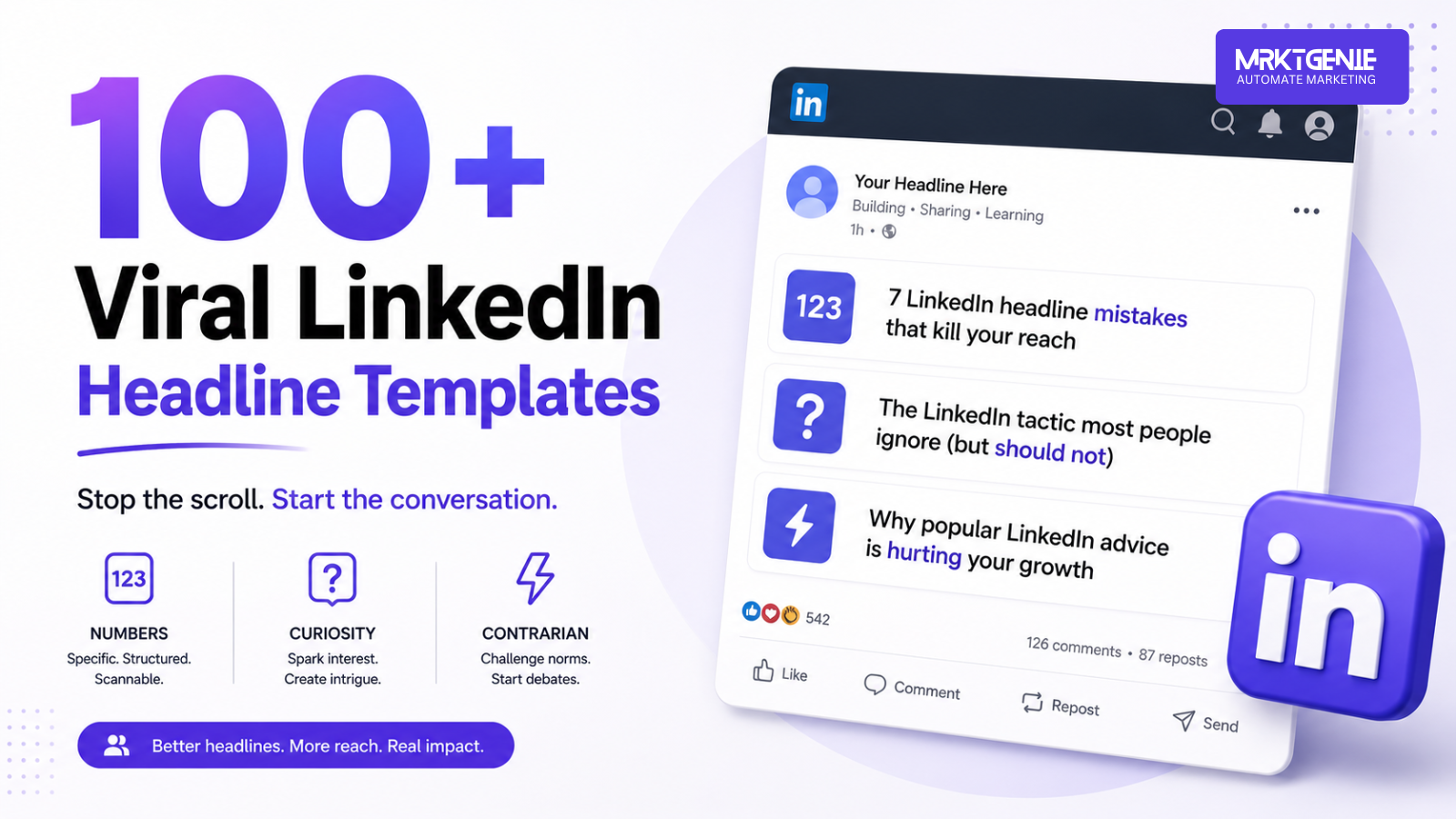
We’re going to cover 100+ viral LinkedIn headline templates built around three patterns that consistently stop scrolling: numbers, curiosity, and contrarian framing. Not because they are magic tricks, but because they match how people actually decide what deserves a click, a pause, or a read.
If your posts are getting ignored, this usually has less to do with the algorithm and more to do with pattern fatigue. I break that down in more detail in why your LinkedIn posts get ignored.
Who these LinkedIn headline templates are really for
This is for the person who knows their field, has real experience, and still watches weaker ideas outperform theirs because those ideas were presented better.
The usual reader here is a founder trying to build authority, a marketer trying to increase reach, a consultant trying to generate leads, or a professional trying to become known for something specific.
The recurring frustration is brutal: you post consistently, you have substance, but your content gets polite silence.
The misconception? That virality comes from saying something wildly original.
Usually it doesn’t.
More often, it comes from making familiar pain feel immediate and impossible to ignore.
The costly mistake is writing headlines that sound like summaries instead of invitations. Headlines are not labels. They are tension devices.
The outcome you want is simple: more stops, more reads, more engagement, and more qualified people associating your name with useful insight.
Why most LinkedIn headlines fail before the post even begins
Here’s a common example:
“Here are some lessons I learned building my startup.”
Nothing technically wrong with it. Also nothing urgent, surprising, or emotionally charged about it.
Now compare it with:
“7 startup lessons I learned too late to call them cheap.”
Same category. Different psychological effect.
The second one creates texture. There is regret. Specificity. A hint of pain. It makes the reader wonder, “Too late in what way?”
That’s the job.
One founder I worked with kept opening posts with lines like “A few thoughts on B2B growth.” Smart person. Strong operator. Invisible posts. We changed one headline to:
“Most B2B growth advice breaks when you have no brand, no budget, and no audience.”
Same brain. Same insight. Completely different result.
This is also why generic expertise often underperforms. People don’t respond to polished vagueness. They respond to relevance and friction. If that sounds familiar, read why thought leadership content usually fails.
The 3 headline patterns that stop scrolling
1. Numbers
Numbers work because they reduce ambiguity. They imply structure. They tell the reader, “This won’t waste your time.”
But not all numbered headlines work equally well.
“5 tips for better networking” feels generic.
“5 networking mistakes that make smart people look forgettable” feels personal.
The number is not the hook. The consequence is.
2. Curiosity
Curiosity works when you leave an information gap without becoming vague or gimmicky.
Bad curiosity sounds like clickbait.
“You won’t believe what happened next…”
Good curiosity sounds like unresolved tension.
“I thought our product had a retention problem. The real issue was much more embarrassing.”
That works because it feels human. It hints at a mistake, and mistakes are magnetic because readers see themselves in them.
3. Contrarian
Contrarian headlines work because LinkedIn is crowded with recycled consensus. The feed is full of people repeating safe advice in slightly different outfits.
When someone says, “Actually, that common advice is wrong,” people pause.
But the best contrarian headlines are not edgy for sport. They challenge a belief the reader half-suspects is flawed.
That’s why posts that question generic startup messaging, fake authority, or overused growth advice often outperform polished how-to content. There’s a reason articles like why users ignore generic startup claims resonate so strongly with founders.
How to use these templates without sounding manufactured
A template should be a skeleton, not a costume.
Too many people copy viral formats word for word, then wonder why the result feels dead. The problem is not the structure. The problem is that the emotional truth inside the structure is fake.
Think of a headline like a movie trailer. The trailer doesn’t need to tell the whole story. But it does need to accurately signal what kind of emotional experience is coming.
If your post is reflective, don’t use an aggressive headline. If your post is tactical, don’t use a melodramatic one. If your post is based on real experience, let the specificity do the heavy lifting.
This is especially important now that AI has made generic phrasing cheap. If you want your content to feel human, not mass-produced, read how founders can use AI without sounding like everyone else.
100+ viral LinkedIn headline templates
Use these as starting points. Adapt them to your voice, your audience, and your actual experience.
Numbers headline templates
- 3 mistakes I made before I understood how this really works
- 5 lessons I learned the expensive way
- 7 things I wish someone had told me earlier
- 10 patterns I keep seeing in companies that stall
- 4 reasons smart people keep getting this wrong
- 6 small changes that made a bigger difference than expected
- 9 assumptions that quietly sabotage growth
- 11 truths nobody mentions when you start
- 8 signs your strategy looks better on paper than in reality
- 5 ways to tell if your messaging is confusing people
- 7 content ideas pulled directly from customer pain
- 3 decisions that changed our trajectory more than any tool
- 6 habits that make someone instantly more credible online
- 10 headline formulas that outperform generic opening lines
- 4 founder mistakes that look productive but aren’t
- 5 marketing activities that feel useful and do almost nothing
- 7 questions I ask before publishing any post
- 8 reasons your audience is scrolling past your content
- 3 uncomfortable truths about building an audience from scratch
- 9 ways to make a boring topic more interesting
- 5 examples of weak positioning and how to fix them
- 6 LinkedIn post openings that consistently earn more reads
- 7 things I stopped doing when I wanted better engagement
- 4 forms of advice that only work if you already have distribution
- 12 content hooks that create instant tension
- 5 lines that make readers think, “This is exactly my problem”
- 7 startup lessons that sounded obvious only after the damage
- 3 reasons your expertise isn’t translating into attention
- 8 simple rewrites that make posts feel sharper
- 10 examples of headlines that say more with fewer words
- 5 audience-building moves that compound quietly
- 6 content mistakes hidden inside “professional” writing
- 7 ways to make practical posts more shareable
- 4 signals that your content is too polished to feel real
- 9 post ideas for days when you have no creative energy
- 5 credibility mistakes founders make on LinkedIn
- 7 examples of specific claims beating generic ones
Curiosity headline templates
- I thought the problem was reach. It was something more fixable
- The post I almost didn’t publish taught me the most
- I ignored this signal for months. That was the mistake
- The real reason people weren’t engaging had nothing to do with quality
- I changed one line and the entire post performed differently
- This looked like a content problem. It was actually a positioning problem
- The most useful feedback I got was also the most annoying to hear
- I used to think consistency was the answer. It wasn’t enough
- The biggest messaging issue wasn’t what we were saying
- I learned this after writing content nobody cared about for too long
- What finally improved our content was not better writing
- I was optimizing the wrong part of the post the whole time
- The lesson came from a post that quietly failed
- I thought this audience wanted expertise. They wanted something else first
- One sentence revealed why the message wasn’t landing
- The fix was embarrassingly simple once I saw it
- This advice sounds smart until you try it with no audience
- There’s a reason some posts feel alive and others feel assembled
- The best-performing post started with a mistake I didn’t want to admit
- I stopped trying to sound impressive and something changed
- The headline worked because it touched a frustration people rarely say out loud
- Most people think they need better ideas. Usually they need better framing
- What looked like low engagement was really low clarity
- I thought I needed more content. I needed more tension
- The surprising part wasn’t what people liked. It was what they ignored
- This one pattern keeps showing up in underperforming posts
- I didn’t expect this type of honesty to outperform polished advice
- Readers weren’t rejecting the idea. They were rejecting the packaging
- The line that got the most engagement was the least “professional” one
- I learned more from one ignored post than from ten decent ones
- The post went viral for a reason most people miss
- There’s a subtle difference between a headline people read and one they skip
- I kept blaming the algorithm until I noticed this pattern
- The strongest hook came from the weakest moment in the story
- People say they want value. Their behavior shows something more specific
Contrarian headline templates
- Most LinkedIn advice rewards activity, not results
- Consistency is overrated if your framing is weak
- Good content does not always win
- More posting is not the answer to forgettable messaging
- Professional-sounding writing is often the reason people keep scrolling
- The safest headline is usually the weakest one
- You do not need more content ideas. You need stronger angles
- Authority online is built less by expertise than by clarity
- Virality is often specificity wearing good timing
- People don’t ignore your post because they’re busy. They ignore it because it feels familiar
- Most “thought leadership” is just summary dressed as insight
- If everyone agrees with your headline, it probably won’t travel far
- The problem with most founder content is not intelligence. It’s emotional flatness
- Being useful is not enough if you are forgettable
- The best hooks often sound less polished, not more
- Data alone rarely stops the scroll
- People trust specific experience more than broad confidence
- Generic value is invisible value
- The algorithm is not your main problem if nobody pauses to read
- Most engagement advice assumes you already have momentum
- The clearer your point, the less you need to sound smart
- Trying to look credible can make your content less believable
- Many low-performing posts are just high-performing posts with weak openings
- What sounds “professional” in a meeting often dies on social media
- Good hooks create recognition before they create interest
- People share posts that articulate tension, not just information
- The best LinkedIn headlines are rarely the most formal ones
- You are not competing with bad content. You are competing with numbness
- Most content strategy problems are really messaging problems
- Strong opinions outperform vague expertise for a reason
- What readers call “valuable” is often just “painfully relevant”
- Shorter is not always better. Sharper is
- If your headline could fit on any post, it is too generic
- Originality matters less than emotional precision
- People don’t want more advice. They want language for what they’re already feeling
How to turn a decent headline into a strong one
Here’s a simple rewrite framework I use.
Step 1: Add consequence
Weak: “5 lessons about hiring”
Stronger: “5 hiring lessons I learned after making avoidable mistakes”
Why it works: lessons alone are abstract; mistakes create stakes.
Step 2: Add specificity
Weak: “How to improve your content”
Stronger: “How to improve your content when you know your niche but still sound generic”
Why it works: people don’t relate to broad improvement. They relate to their exact stuck point.
Step 3: Add tension
Weak: “My thoughts on startup growth”
Stronger: “Startup growth advice sounds clean until you try it with no money, no team, and no audience”
Why it works: tension makes the reader feel the mismatch between theory and reality.
This same principle shows up far beyond LinkedIn. It’s also why so many startup homepages fail in seconds. Clarity without tension becomes wallpaper. If that’s relevant to your brand, read why most startup websites fail in 5 seconds.
3 real-world headline makeovers
Example 1: The founder post nobody read
Original headline:
“What I learned building in public”
Better versions:
- 7 things building in public taught me that private building never could
- I thought building in public would attract users. It exposed a different problem
- Building in public is overrated if you still can’t explain what you do
Notice what changed? Not the topic. The angle.
Example 2: The consultant post that sounded too safe
Original headline:
“Tips for better B2B messaging”
Better versions:
- 5 B2B messaging mistakes that make strong products sound ordinary
- The real reason your B2B messaging isn’t landing is less flattering than you think
- Most B2B messaging advice ignores one thing buyers actually notice
Now the reader can feel the stakes.
Example 3: The creator post that finally clicked
A creator once told me, “I’m saying useful things. Why does it feel like I’m posting into a void?”
Her original opening line was:
“A few content lessons from my recent experience.”
We changed it to:
“I wrote useful content for months. Nobody cared until I stopped sounding useful.”
That line worked because it named a contradiction people live through but rarely articulate.
That’s the deeper lesson: strong headlines often compress a felt truth, not just a topic.
What makes a LinkedIn headline feel human instead of engineered
The best headlines usually contain one of these:
- A mistake
- A cost
- A contradiction
- A specific frustration
- An unexpected result
- A belief reversal
Why? Because people don’t stop for information alone. They stop for recognition.
When someone reads, “I kept blaming the algorithm until I noticed this pattern,” they are not just reacting to curiosity. They are reacting to self-recognition. They’ve done that too.
This matters more than ever because attention is becoming less technical and more psychological. Distribution still matters, but perception, trust, and emotional precision matter more than most people realize. That’s a bigger theme in why startup growth is becoming more psychological than technical.
A quick decision framework: which headline type should you use?
Use number-based headlines when:
- You’re teaching a process
- You have clear takeaways
- You want to reduce reader uncertainty
- Your post is practical or tactical
Use curiosity-based headlines when:
- You have a story
- You learned something surprising
- You want to create an information gap
- Your post contains a reveal, mistake, or reversal
Use contrarian headlines when:
- You disagree with common advice
- You want to challenge a stale assumption
- You have evidence from real experience
- Your audience is tired of generic consensus
If you’re unsure, ask one question:
What emotional reaction should the first line create: clarity, intrigue, or friction?
Your answer usually tells you which category to use.
Common mistakes that ruin otherwise strong LinkedIn headlines
- Being broad when you should be specific
- Sounding polished when you should sound real
- Using curiosity with no payoff
- Being contrarian without substance
- Writing headlines that summarize instead of provoke
- Copying templates too literally
- Trying to impress instead of trying to resonate
One of the strangest things about LinkedIn is that many smart professionals write as if they’re submitting a conference abstract. Clean. Accurate. Lifeless.
But readers don’t reward restraint. They reward relevance.
Final thought: headlines don’t win because they are clever
They win because they make someone feel seen fast.
That’s the shift.
A strong LinkedIn headline is not a trick for beating the feed. It is a compressed signal that says, “This post understands something you’re dealing with.”
So before you publish your next post, don’t ask, “Is this headline good?”
Ask:
Would the right person feel recognized by this in under two seconds?
If the answer is no, keep rewriting.
Because the scroll does not stop for effort.
It stops for emotional precision.