If you cannot explain your startup in one sentence, you do not have a messaging problem alone. You likely have a positioning problem. In crowded markets, clarity is not a nice-to-have. It is a growth tool. A sharp one-line explanation helps investors understand your opportunity, customers understand your value, and your own team stay aligned on what you actually do.
This guide shows how to explain your startup in one sentence with a practical framework, examples, and testing methods you can use immediately. If you want better startup messaging clarity, stronger positioning, and a pitch people remember, start here.
Why clarity wins
Clear startup messaging works because people are busy, distracted, and skeptical. They do not want to decode vague claims or trendy language. They want to know what your company does, who it helps, and why it matters. The faster they get that answer, the more likely they are to keep listening.
A strong one-sentence startup pitch creates benefits across every audience:
- Customers quickly see whether your product is relevant.
- Investors understand the market, problem, and wedge faster.
- Journalists can describe your company accurately.
- New hires grasp the mission and value proposition.
- Your internal team makes better product and marketing decisions.
Clarity also signals confidence. Founders often hide behind abstract language when they are still figuring out their market. But the most compelling startup messaging is usually the simplest. If a smart outsider cannot repeat your pitch after hearing it once, it is probably too complex.
Clarity is not dumbing down your startup. It is making your value easy to understand.
Many startups lose attention because they lead with category labels, technical architecture, or broad ambition. Those can matter later. In the first sentence, what matters is immediate comprehension.
Simple positioning structure
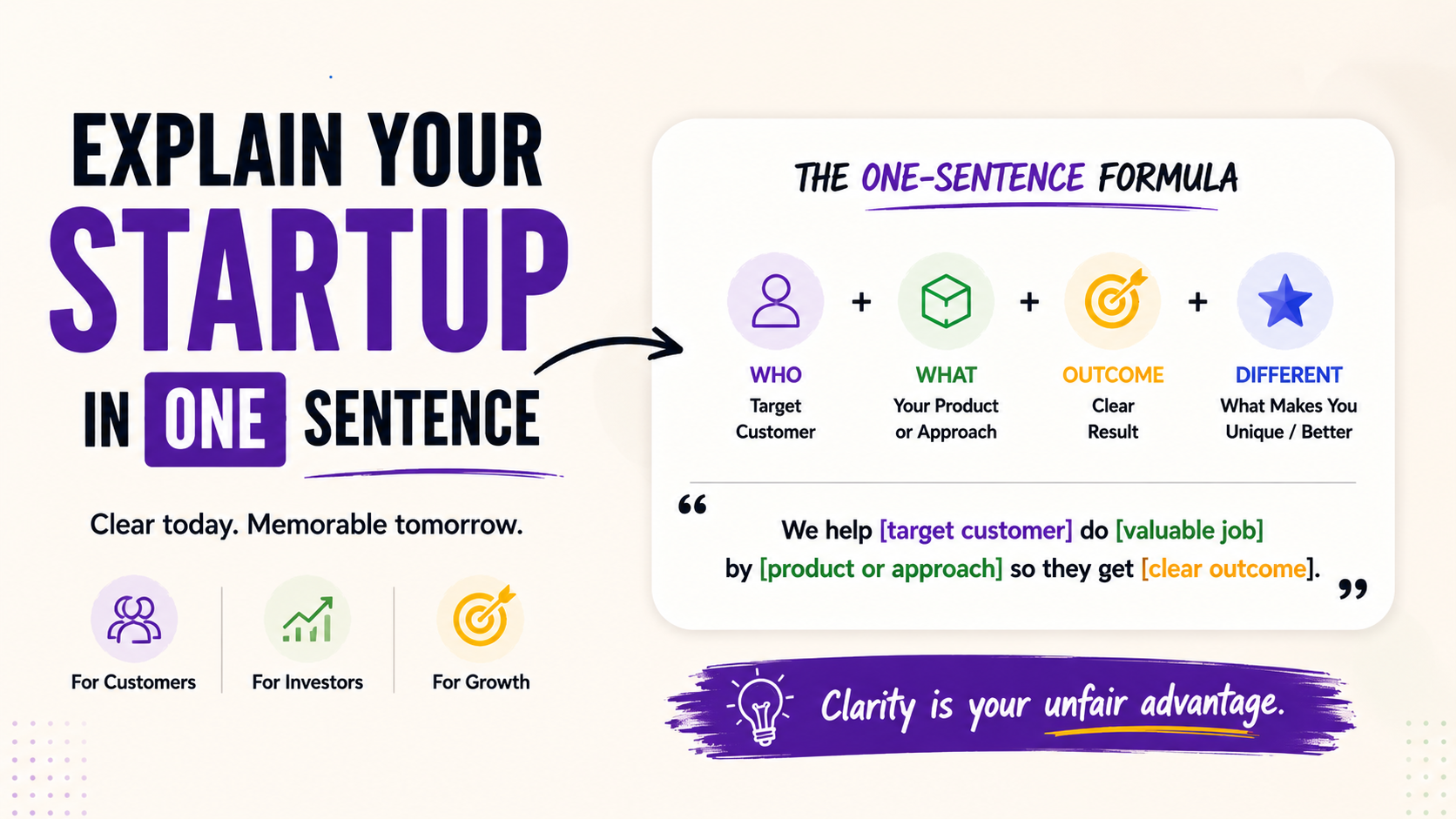
The easiest way to explain your startup in one sentence is to use a simple positioning structure. Your sentence should answer four questions:
- Who is it for?
- What does it do?
- What outcome does it create?
- What makes it different or easier?
A reliable formula looks like this:
We help target customer do valuable job by product or approach so they get clear outcome.
Here are a few variations you can use:
- We help target customer solve problem with product so they can outcome.
- Product is a category for target customer that benefit.
- Unlike alternative, product helps target customer outcome through differentiator.
The point is not to sound formulaic. The point is to force precision. A good one-sentence startup explanation usually includes:
- A specific customer, not everyone.
- A concrete problem, not a broad mission.
- A tangible result, not a vague promise.
- A plain-English description, not insider language.
What strong startup positioning sounds like
Good startup positioning is narrow enough to be believable and broad enough to be useful. For example, compare these two structures:
Weak: We are building the future of intelligent commerce infrastructure.
Strong: We help independent online stores automate inventory and reordering so they avoid stockouts and save hours each week.
The second version tells you who it serves, what it does, and why it matters. It is easier to trust because it is easier to picture.
Bad examples vs good examples
One of the fastest ways to improve startup messaging clarity is to study weak and strong versions side by side. Here are common bad patterns and better alternatives.
Example 1: Too vague
Bad: We are a next-generation wellness platform transforming human potential.
Good: We help HR teams offer employees personalized mental health support through a mobile app and live coaching.
Why it works: The good version replaces abstraction with audience, product, and value.
Example 2: Too technical
Bad: We provide AI-powered orchestration for multimodal enterprise knowledge retrieval.
Good: We help support teams find answers across company documents and tickets in seconds using AI search.
Why it works: It explains the use case instead of the machinery.
Example 3: Too broad
Bad: We are changing how people work.
Good: We help remote product teams run faster weekly planning meetings with shared agendas, notes, and action tracking.
Why it works: Specificity creates credibility.
Example 4: Too buzzword-heavy
Bad: We unlock synergies across decentralized creator ecosystems.
Good: We help creators sell memberships and digital products from one storefront without relying on social platform algorithms.
Why it works: Real words beat fashionable language.
Example 5: Too feature-focused
Bad: Our platform includes workflow automation, analytics dashboards, API integrations, and role-based permissions.
Good: We help finance teams close the books faster by automating recurring reconciliation tasks.
Why it works: Buyers care about outcomes before features.
As a rule, your startup one-liner should not make people ask, “What does that mean?” It should make them ask, “How does that work?” That is progress.
Removing jargon
Jargon is one of the biggest enemies of startup messaging. Founders often use it for three reasons: they are immersed in their industry, they want to sound sophisticated, or they are avoiding a hard positioning choice. None of those help the listener.
To remove jargon, start by identifying words that are common inside your company but unclear outside it. These often include terms like:
- Platform
- Solution
- Ecosystem
- Revolutionary
- Seamless
- Intelligent
- End-to-end
- Next-generation
- Disruptive
- Leverage
These words are not always wrong, but they are often empty. Replace them with language that a customer would naturally use. Instead of saying “workflow optimization,” say “cut manual data entry.” Instead of saying “frictionless onboarding,” say “new users can get started in five minutes.”
How to simplify your startup sentence
- Use nouns people can picture.
- Use verbs that describe action.
- Name the customer directly.
- Describe the problem in everyday language.
- Focus on one main benefit.
- Cut adjectives that do not add meaning.
A good test is this: would a customer repeat your sentence to a colleague without changing the words? If not, it may still be too abstract.
If your pitch sounds like it belongs on a conference stage, rewrite it until it sounds like a useful answer in a real conversation.
Testing your pitch
Writing a one-sentence startup explanation is not a branding exercise you do once. It is a message you test in the market. The right pitch is usually discovered through repetition, feedback, and refinement.
Here are practical ways to test your pitch:
1. The five-second test
Show your sentence to someone outside your company for five seconds. Then ask:
- What do you think this startup does?
- Who do you think it is for?
- What benefit do you think it provides?
If they cannot answer accurately, your message needs work.
2. The repeat-back test
Say your sentence out loud in conversation. Then ask the listener to repeat what they heard. If they simplify it into something better, use their version as inspiration.
3. The landing page test
Put different one-line messages on your homepage or ad creative and compare conversion rates. Startup messaging clarity often shows up in metrics like:
- Higher click-through rates
- Lower bounce rates
- More demo requests
- More qualified signups
4. The sales call test
Listen to recorded sales or discovery calls. Notice which wording makes prospects lean in, ask follow-up questions, or immediately understand the value. Your best pitch may already be hiding in a conversation.
5. The investor intro test
Send your sentence to a trusted investor or advisor and ask them to introduce your company to someone else using only that line. If they mischaracterize the business, your positioning may be incomplete or misleading.
As you test, optimize for comprehension first, memorability second, and cleverness last. The best startup one-liners are rarely the most creative. They are the easiest to understand.
Real startup examples
Below are examples of how real startup categories can be explained in one sentence more clearly. These are not official company taglines. They are examples of effective messaging structure.
Fintech startup
We help small businesses get paid faster by automating invoices, reminders, and payment collection.
Why it works: It identifies the customer, the problem, and the business outcome.
Healthtech startup
We help clinics reduce no-shows by sending patients personalized appointment reminders and follow-up messages.
Why it works: It focuses on a measurable pain point instead of broad healthcare transformation language.
SaaS startup
We help customer success teams spot at-risk accounts early using product usage and support data.
Why it works: It is specific, outcome-driven, and easy for a buyer to map to a workflow.
Developer tools startup
We help engineering teams catch breaking API changes before they reach production.
Why it works: It translates technical value into a practical job to be done.
Marketplace startup
We help independent chefs sell meal subscriptions directly to local customers.
Why it works: It makes the business model and customer value immediately clear.
Edtech startup
We help schools identify students who are falling behind by turning assessment data into simple weekly alerts.
Why it works: It avoids generic claims about transforming education and focuses on a real use case.
Climate startup
We help commercial buildings cut energy costs by automatically adjusting HVAC systems in real time.
Why it works: It ties climate impact to an economic benefit decision-makers care about.
How to write your one-sentence startup pitch
If you want a repeatable process, use this quick exercise:
- Write down your target customer in one phrase.
- Write down the top problem they urgently want solved.
- Write down what your product actually does.
- Write down the clearest outcome it creates.
- Write down why your approach is easier, faster, or better.
Then combine those pieces into one sentence. For example:
We help target customer solve problem with product so they can outcome.
Now edit aggressively. Remove filler. Replace broad words with concrete ones. Cut anything that would require explanation. Read it aloud. If it sounds unnatural, simplify again.
Common mistakes to avoid
- Trying to say everything in one sentence.
- Leading with vision before value.
- Using category terms your audience does not understand.
- Describing features instead of outcomes.
- Targeting everyone instead of a specific user.
- Sounding impressive instead of sounding clear.
Your one sentence does not need to capture every edge case, feature, or future ambition. It only needs to open the door. Think of it as the sharpest possible summary of your current value proposition.
Final thought: clarity is a strategic advantage
Learning how to explain your startup in one sentence is not just a copywriting skill. It is a strategic discipline. Clear messaging forces better thinking about customer, problem, value, and differentiation. It helps your startup stand out because most companies still communicate in language that is too broad, too technical, or too forgettable.
If your startup pitch is hard to say, it will be hard to sell. If it is easy to understand, people can carry it for you. That is when messaging starts to compound.
A great one-liner is simple, specific, and useful. It tells the right person, in plain language, why your startup matters. Start there, test it often, and keep refining until people get it instantly.