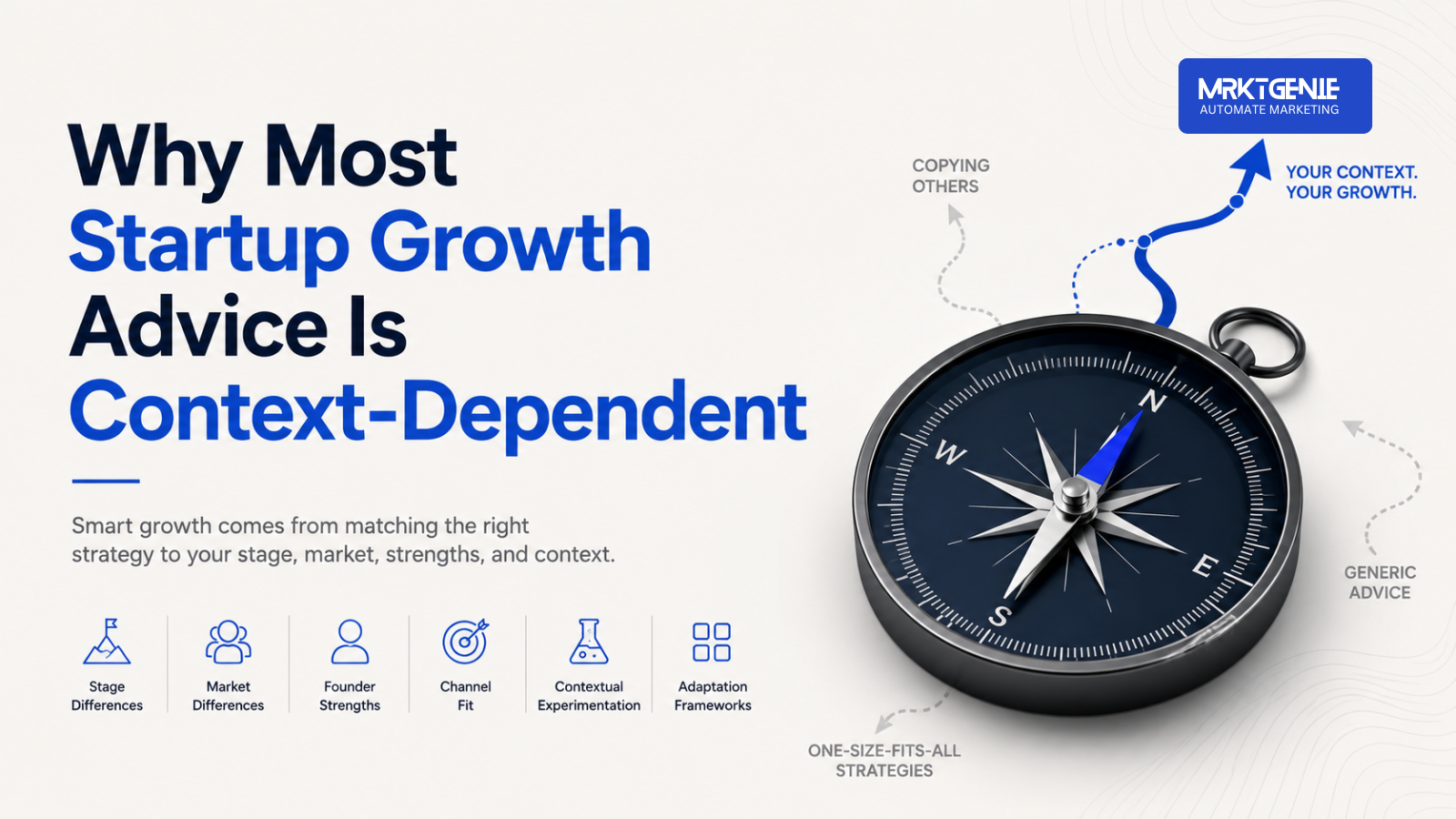
Startup growth advice is often packaged as universal truth: launch faster, hire sales early, double down on paid acquisition, build in public, ship daily, niche down, expand upmarket. The problem is not that these ideas are inherently wrong. The problem is that they are usually right only within a specific set of conditions. When founders borrow tactics without understanding the context that made them effective, they confuse another company’s circumstances for their own strategy.
That is why blindly copying advice so often backfires. A growth playbook that worked for a venture-backed SaaS company with a seasoned sales leader, a warm investor network, and a high-ACV product may fail completely for a bootstrapped founder selling a low-ticket workflow tool into a crowded market. Advice travels faster than nuance. Outcomes get celebrated, while prerequisites are omitted.
For founders trying to scale intelligently, the more useful question is not, “What worked for them?” but, “Under what conditions did that work, and do those conditions exist here?” This is where a more disciplined growth lens matters. Rather than treating tactics as commandments, founders should evaluate stage, market, team strengths, channel dynamics, and the feedback loops available to them. In other words, growth is less about copying and more about contextual matching.
At Mrkt Genie’s blog, a recurring theme across startup and marketing guidance is that performance improves when strategy aligns with customer reality, execution capacity, and channel economics. That principle is especially important when interpreting growth advice.
1. Stage Differences
The single biggest reason startup advice breaks down is that most recommendations are stage-specific, even when presented as if they apply to everyone. What a pre-product-market-fit startup needs is fundamentally different from what a scaling company needs. Yet many founders consume advice from companies far ahead of them and apply it prematurely.
Pre-Product-Market Fit
At the earliest stage, growth is rarely the core problem. Discovery is. The company is still learning who the customer is, what pain matters most, how urgent the need is, and what language resonates. In this phase, the obsession with scale can become a liability because it amplifies an unproven message to the wrong audience.
Advice such as “invest in SEO immediately” or “build a sales team now” may be counterproductive if the startup has not yet validated positioning, onboarding, retention, or willingness to pay. Before acceleration comes clarity. Founders need tight feedback loops, direct customer conversations, and experiments that reveal fit, not vanity traction.
Post-Product-Market Fit
Once a company has evidence of repeatable demand, the challenge shifts from discovery to efficiency and repeatability. This is where channel optimization, funnel design, content systems, outbound sequencing, and lifecycle marketing begin to matter much more. Tactics dismissed as premature earlier can become essential later.
A founder who ignored paid acquisition before finding fit may be wise. The same founder refusing to operationalize acquisition after finding fit may become a bottleneck. Stage changes the right answer.
Early Scale vs. Mature Scale
Even within growth stage companies, context matters. A startup trying to go from zero to its first million in ARR should not necessarily copy the process of a company moving from ten million to fifty million. The latter may be optimizing cross-functional systems, attribution infrastructure, and team specialization. The former may need a narrower ICP, stronger proof points, and one dependable acquisition motion.
Growth advice only becomes useful when founders ask: what stage was the company in when this tactic worked? Without that filter, recommendations become misleading abstractions.
2. Market Differences
Markets shape growth more than generic advice acknowledges. Customer urgency, competition, deal size, buying committee complexity, market maturity, and regulatory friction all influence what works. A tactic that converts in one market may underperform in another not because execution is poor, but because the market itself behaves differently.
B2B vs. B2C Dynamics
Customer acquisition in B2B often depends on trust, education, and stakeholder alignment. In B2C, speed, emotion, habit, and pricing psychology may dominate. Founders who import consumer growth tactics into enterprise software can end up generating attention without conversion. Conversely, founders who overcomplicate a simple consumer product with enterprise-style messaging can kill momentum.
Category Maturity
If a startup operates in an established category, customers may already understand the problem. In that case, the challenge is differentiation. But if the company is creating a new category or introducing an unfamiliar approach, education becomes part of the growth engine. That changes content strategy, sales cycles, and conversion expectations.
In mature markets, comparison pages and bottom-of-funnel search intent can perform well. In emerging markets, thought leadership and problem framing may be more effective because customers are not yet searching with precision. Advice that ignores category maturity often misguides channel selection.
Competitive Density
In crowded markets, messaging precision matters more. Broad promises disappear into the noise. Startups need sharper positioning, stronger proof, and clearer reasons to switch. In less saturated spaces, speed and visibility may matter more than nuanced differentiation.
This is one reason strategic messaging work becomes foundational. Strong growth does not begin with channels alone; it begins with relevance. Founders exploring how positioning affects demand generation may benefit from related thinking on brand, messaging, and startup marketing strategy on the Mrkt Genie blog, where the emphasis consistently leans toward matching communication to audience intent rather than relying on generic templates.
3. Founder Strengths
Advice often assumes the founder is interchangeable. In reality, founder strengths materially influence what growth strategy is viable. A deeply technical founder, a charismatic community builder, and a process-oriented operator will each unlock traction differently. The best strategy is not merely what is theoretically optimal. It is what the team can execute exceptionally well right now.
Founder-Led Sales vs. Product-Led Momentum
Some founders are extraordinary in customer conversations. They can uncover pain, handle objections, and build trust quickly. For them, founder-led sales can be a powerful early growth engine. Others are better at product design, distribution systems, or content. Forcing every founder into the same playbook ignores comparative advantage.
If a founder is weak at outbound sales but excellent at creating educational content, a content-driven trust engine may outperform an aggressive outbound motion in the near term. If another founder has an exceptional network in a narrow industry, relationship-led distribution may beat broad digital acquisition.
Team Composition and Bandwidth
Advice also tends to overlook the practical limits of small teams. A recommendation to build a multi-channel growth engine can sound compelling, but it may be unrealistic for a two-person startup. Execution quality drops when focus fragments. The better move is often choosing one or two channels that match the team’s capabilities and compounding there.
This is where many startups confuse ambition with strategy. They do not fail because they aimed too high. They fail because they tried to operationalize advice that required more people, more expertise, and more consistency than they had available.
The most dangerous growth advice is not bad advice. It is good advice detached from the conditions that made it good.
4. Channel Fit
One of the most persistent myths in startup growth is that there is a best channel. In truth, there is only channel fit. Every acquisition channel has its own economics, time horizon, learning curve, and dependence on message-market alignment. What works depends on where attention already exists, how customers evaluate solutions, and how quickly trust can be built.
SEO Is Powerful, but Not Universal
SEO can be a durable growth engine, but it is not automatically the right first move. If buyers search actively for the problem and the startup can produce credible, differentiated content, SEO can compound beautifully. But if the category is new, search volume is low, or the startup lacks the authority to compete, SEO may be a slow and frustrating path initially.
Paid Acquisition Requires More Than Budget
Paid channels are often recommended because they are measurable and fast. Yet they punish weak positioning. If the startup has unclear messaging, low conversion rates, or poor retention, paid traffic simply accelerates waste. Paid acquisition works best when the funnel is instrumented, the offer is validated, and the economics can be sustained.
Outbound Works When Precision Exists
Outbound can generate fast learning in B2B, but only when the startup understands its ICP, has a strong problem hypothesis, and can articulate why the prospect should care now. Spray-and-pray outbound, copied from generic templates, usually damages domain reputation and morale more than it builds pipeline.
Content and Community Need Time
Content marketing and community-led growth are often praised because they can create trust and defensibility. That is true, but they are slower to mature and harder to fake. They work best when the company has a distinctive point of view, consistency, and enough patience to let credibility accumulate.
The lesson is simple: channels are not universally good or bad. They are appropriate or inappropriate given the startup’s market, offer, resources, and timing.
5. Contextual Experimentation
If growth advice is context-dependent, then the right response is not cynicism. It is experimentation. Founders do not need to reject outside advice entirely. They need to treat it as a hypothesis, not a prescription.
Turn Advice Into Testable Assumptions
Instead of asking whether a tactic is right in general, ask what must be true for it to work here. For example:
- Will this channel reach our ideal customer at sufficient intent?
- Do we have the positioning clarity to convert the traffic or attention it generates?
- Do we have the operational capacity to run this consistently for long enough?
- What leading indicators will tell us whether this is working before we overspend?
This approach transforms borrowed advice into structured learning. It also reduces the emotional volatility that often comes from trying a tactic once, seeing weak results, and declaring it dead.
Use Small Bets Before Big Commitments
Contextual experimentation means starting with constrained tests. A startup considering outbound does not need to build a full SDR team immediately. It can test messaging with a narrow segment first. A company considering SEO does not need to publish fifty articles blindly. It can validate search intent and conversion from a focused cluster. A founder curious about webinars can run one for a tightly defined audience before institutionalizing the format.
Small bets produce evidence. Evidence creates confidence. Confidence justifies scale.
Measure Learning, Not Just Volume
Early experiments should not be judged only by top-line volume. A campaign that generates modest numbers but reveals high-intent messaging may be more valuable than one that produces more clicks with no downstream quality. Contextual growth requires founders to pay attention to signal quality, not just dashboard activity.
This mindset aligns with the broader strategic discipline often emphasized across Mrkt Genie’s startup marketing insights: sustainable growth comes from understanding what drives meaningful customer response, not from chasing surface-level metrics.
6. Adaptation Frameworks
The most effective founders build frameworks for adapting advice rather than memorizing tactics. A framework helps them absorb external ideas without becoming captive to them. It creates a repeatable way to decide what to test, what to ignore, and what to scale.
The Context Filter
Before adopting any advice, run it through five filters:
- Stage: Are we at the same stage as the company giving this advice?
- Market: Do our buyers, category dynamics, and competitive conditions resemble theirs?
- Model: Is our pricing, sales cycle, and retention profile similar enough?
- Capability: Do we have the team, skills, and bandwidth required?
- Economics: Can this channel or tactic work within our margins and timelines?
If the answer to several of these is no, then the advice may still be interesting, but it should not be treated as immediately actionable.
The 70/20/10 Growth Allocation
A practical adaptation model is to allocate effort across three buckets:
- 70% on proven motions already showing traction
- 20% on adjacent experiments with a reasonable contextual fit
- 10% on high-variance bets inspired by external advice or emerging opportunities
This prevents startups from becoming either too rigid or too distracted. They preserve momentum while still learning.
The Founder-Market Match Lens
Another useful framework is to assess growth strategy through founder-market match. Ask:
- What strengths do we naturally possess as a team?
- Which channels reward those strengths?
- Where do our customers already trust voices like ours?
- What motion can we sustain with excellence for the next six to twelve months?
Often, the best early growth strategy is the one the team can execute with unusual conviction and consistency. Startups do not need the most fashionable playbook. They need the most coherent one.
The Real Discipline Behind Smart Growth
Most startup growth advice is context-dependent because startups themselves are context-dependent. They differ in stage, market, product complexity, founder strengths, resources, urgency, and customer behavior. To ignore those differences is to mistake storytelling for strategy.
The elite founder does not collect tactics like trophies. They interrogate them. They ask what conditions made a recommendation succeed, whether those conditions exist in their business, and how to test the underlying idea with minimal waste. They understand that copying is easy, but adaptation is what compounds.
Blindly copying advice often backfires because borrowed certainty feels efficient while actually delaying understanding. Contextual experimentation, by contrast, may look slower at first, but it produces something much more valuable: a growth system built around reality rather than imitation.
For founders and marketers refining that system, the broader body of thinking on the Mrkt Genie blog is a useful place to continue exploring practical approaches to positioning, demand generation, and sustainable startup marketing. The central lesson remains the same: growth is never just about what works. It is about what works here.