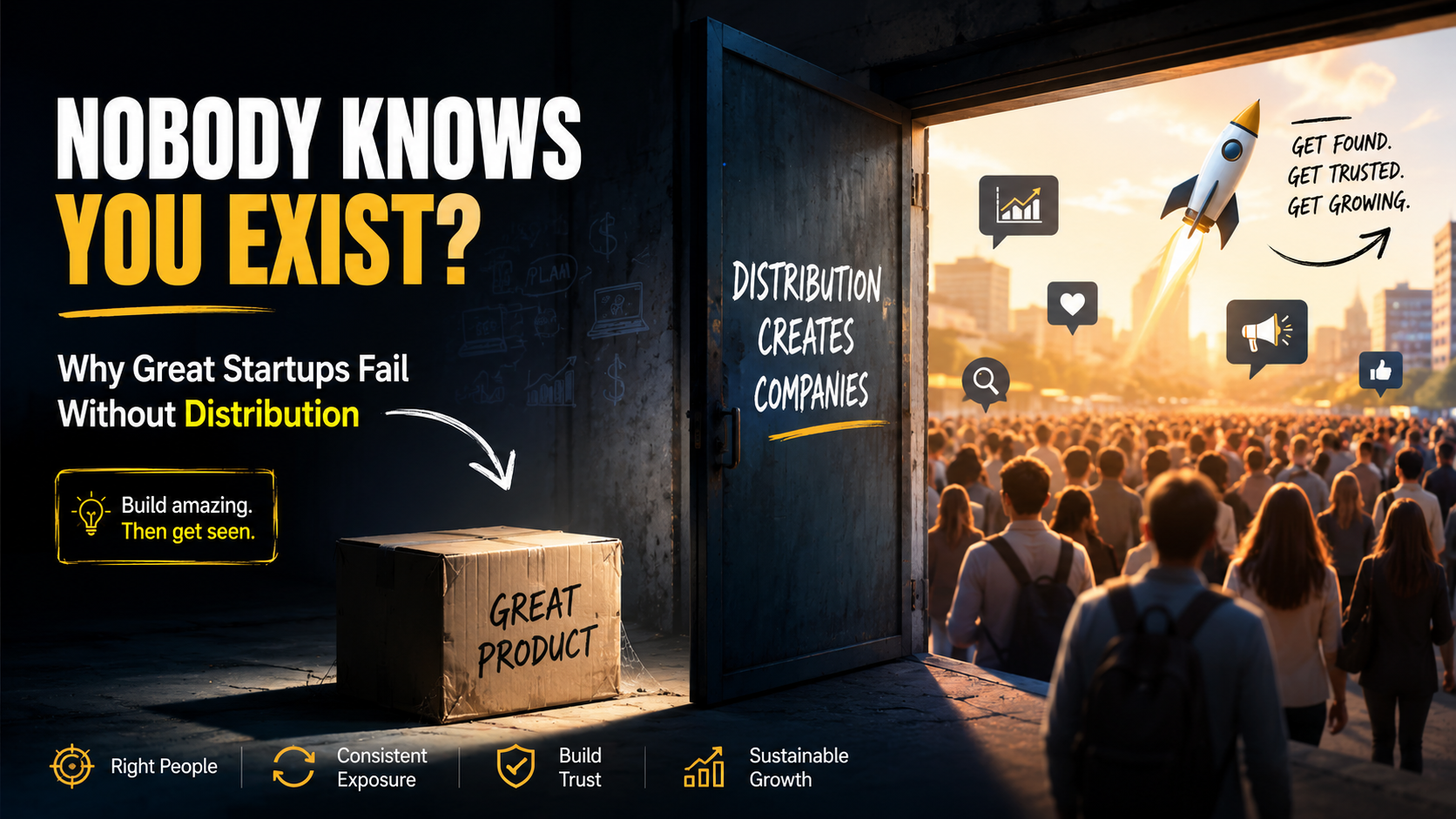
Most startups do not fail because the product is terrible. They fail because almost nobody knows they exist. That is a painful truth for founders who spend months, sometimes years, refining features, polishing onboarding, and chasing technical perfection. The assumption is simple: if we build something valuable, people will notice. But in early-stage startups, attention is not a reward for effort. It is a system you have to design.
If nobody cares about your startup yet, it does not automatically mean your idea is bad. It usually means your distribution is weak, inconsistent, or nonexistent. In the beginning, visibility matters more than elegance. Reach matters more than roadmap depth. And learning how to get in front of the right people matters more than shipping one more feature that nobody asked for.
This is the uncomfortable gap many founders miss: building creates a product, but distribution creates a company.
The exposure illusion
Founders live close to their product. They think about it every day. They talk to teammates, investors, early users, and friends about it constantly. That proximity creates a dangerous illusion: because the startup feels important inside the founder’s world, it must be visible in the market.
It is not.
The internet is crowded, noisy, and brutally competitive. Your startup is competing not only with direct rivals, but with every other piece of content, every other tool, every other message, and every other demand on your audience’s time. People are not waiting to discover your landing page. They are busy solving their problems with whatever is already in front of them.
Exposure does not happen by default. Publishing a website is not distribution. Launching on Product Hunt is not a growth strategy. Posting three times on social media is not market penetration. These are events, not systems.
The exposure illusion leads founders to overestimate awareness and underestimate repetition. In reality, most people need multiple touchpoints before they remember a startup, trust it, and decide to try it. If your company is not showing up repeatedly in relevant places, you are effectively invisible.
Attention is rarely earned by existence alone. It is earned by repeated, relevant exposure.
This is why many startups feel stuck. The founders believe they have launched, but the market has barely noticed. They mistake availability for discoverability. A product can be live and still be hidden.
Why good products stay invisible
There is a comforting myth in startup culture that great products naturally rise to the top. In practice, many good products stay invisible for a very long time. Quality helps with retention, referrals, and long-term defensibility, but it does not guarantee initial attention.
Early-stage markets do not reward quality alone. They reward awareness, clarity, timing, and access. A strong product without distribution is like a brilliant book left in an empty room. Its value does not matter until someone opens the door.
There are several reasons good products stay unnoticed.
They solve a real problem, but tell the story poorly
Founders often understand the product better than the customer understands the problem. As a result, messaging becomes feature-heavy, abstract, or overly technical. The startup may be useful, but if the audience cannot immediately grasp why it matters, they move on.
They target too broad an audience
Trying to appeal to everyone usually means resonating with no one. Broad positioning weakens word-of-mouth because nobody feels the product was built specifically for them. Narrow products often grow faster because they create stronger relevance.
They rely on passive discovery
Many founders assume SEO, app stores, social platforms, or communities will somehow surface their product organically. But passive discovery is slow and unreliable unless there is already demand, authority, or a content engine behind it.
They launch once instead of distributing continuously
A launch creates a temporary spike. Startups need ongoing visibility. If all attention depends on a single announcement, momentum disappears quickly and the company returns to silence.
They underestimate trust
People do not adopt unknown tools easily, especially in crowded categories. Even if your product is objectively better, prospects often choose familiar options because familiarity feels safer. Distribution is not just about reach. It is about building enough credibility that trying your startup feels low-risk.
This is why a mediocre product with strong distribution can outperform a better product with weak visibility, at least in the short term. Distribution gets the first chance. Product quality determines what happens after that chance arrives.
Distribution vs product obsession
Founders love building because building feels productive. It is measurable, controllable, and emotionally satisfying. You can point to a shipped feature and say progress was made. Distribution feels messier. It involves rejection, ambiguity, repetition, and public indifference. So many founders retreat into product work because it is more comfortable than facing the market.
That instinct is understandable, but dangerous.
In the early stage, the main job is not to perfect the product in isolation. The main job is to find a repeatable path between what you built and the people who need it. That path is distribution.
Product obsession sounds noble, but it often hides avoidance. A founder says, “We need to improve the product before pushing it harder,” when the real issue is fear that the market may not respond. More features become a shield against feedback.
The better question is not, “How do we make this product more complete?” It is, “How do we get this product in front of the right people often enough to learn what matters?”
At the beginning, distribution should shape product decisions. If a channel consistently brings in a certain type of user, the product should evolve around that user’s needs. If a message gets strong engagement, it should influence positioning. If a community responds to one use case more than another, that signal matters. Distribution is not separate from product strategy. It is one of the fastest ways to discover what the product should become.
Strong startups usually develop product and distribution together. They do not wait for perfection before promoting. They ship, share, learn, refine, and repeat. That loop compounds.
Common founder mistakes
Most early-stage attention problems come from a handful of recurring mistakes. They are common because they feel rational in the moment, but they quietly stall growth.
Building too long before talking to the market
Stealth can feel strategic, but long periods of private building often delay the most important learning. Founders emerge with a polished product and discover that nobody understands it, wants it, or hears about it. Market conversations should begin early, even before the product is fully ready.
Confusing audience with users
You do not only need users. You need an audience that can repeatedly hear from you. An owned audience through email, content, community, or social presence creates leverage. Without it, every growth effort starts from zero.
Talking about features instead of outcomes
Customers care less about what your product has and more about what it helps them do. Feature lists rarely spread. Clear outcomes do. “Automated reporting for finance teams” is less compelling than “Close your monthly reporting in half the time.”
Choosing channels based on preference, not fit
Founders often default to channels they personally enjoy. But the right distribution channel depends on where the target customer already pays attention. If your buyers live in niche communities, broad social posting may do little. If they search for solutions actively, SEO may matter more. Channel strategy should follow customer behavior, not founder comfort.
Expecting immediate traction
Distribution takes repetition. Most channels require consistency before they produce meaningful results. Founders quit too early because they expect one campaign, one launch, or one viral moment to change everything. Sustainable attention is usually built through accumulation, not sudden spikes.
Ignoring retention while chasing awareness
Attention without product value leaks fast. If people try the startup and leave immediately, distribution becomes expensive noise. The goal is not just to get seen. It is to create a system where attention turns