It usually starts the same way. You publish something you know is useful. A thoughtful post. A sharp landing page. A customer story that should resonate. Then nothing happens. A few impressions. A polite like from a friend. Maybe one comment from someone trying to sell you lead gen services.
Meanwhile, a lower-quality post from a louder competitor takes off. Another AI-wrapped startup appears overnight with a cleaner hook, a bigger distribution engine, and a founder who seems to live inside your feed. You are not imagining it. Startup marketing does feel harder than ever. Not because you suddenly got worse at it, but because the market for attention has become brutally efficient at ignoring anything unclear, generic, or dependent on rented channels.
If you are a founder or early-stage marketer, you are probably trying to solve a simple problem that now feels absurdly complicated: how do we get the right people to notice us, trust us, and eventually buy from us without burning through cash and morale? The recurring frustration is that you are doing work, sometimes a lot of it, but the output does not seem to compound. The common misconception is that the answer is more content, more channels, more consistency. The costly mistake is confusing activity with distribution, and distribution with demand. What you actually want is not more marketing. You want traction that feels earned, repeatable, and sane.
There is now an infinite supply of content, and most of it is forgettable
A few years ago, publishing was the bottleneck. Now attention is the bottleneck. Anyone can generate ten blog posts before lunch, schedule thirty social posts by dinner, and wake up feeling productive. The internet has become a warehouse of competent-looking material with no pulse.
I recently watched a SaaS founder proudly show a six-week content calendar: SEO articles, founder posts, email newsletters, product updates, and short-form videos. On paper, it looked disciplined. In reality, every asset said some variation of the same empty thing: we help teams work smarter with AI. It was content in the same way packing peanuts are shipping material. A lot of volume, very little substance.
This is why startup marketing feels heavier now. You are not just competing against other startups in your category. You are competing against infinite drafts, recycled takes, templated thought leadership, and AI-generated sludge that has lowered the average quality floor while raising the standard for anything worth remembering.
The painful part is that good work can still disappear. Not because it lacks value, but because value alone is no longer enough. It has to be specific enough to stop the scroll, relevant enough to trigger self-recognition, and distinct enough to survive comparison.
That is one reason generic founder content gets ignored. If that pattern feels familiar, this breakdown of why LinkedIn posts get ignored explains the mechanics well.
The new competition is not quality versus quality
It is clarity versus noise.
Most startups think they are losing because they need better copy. Often they are losing because their message could describe fifty other companies. When every homepage says faster, smarter, seamless, or scalable, the winner is not the one with the best adjective. It is the one that makes the reader feel, finally, someone understands my exact problem.
If your marketing can be mistaken for a category summary, it will be treated like background noise.
Attention is fragmented into tiny, unreliable windows
Your buyer is not sitting down to calmly absorb your brand narrative. They are half-reading your post between meetings, skimming your homepage with twelve tabs open, saving your article to read later, then never reading it later.
This changes the job of marketing. You are no longer building one persuasive path. You are building many small moments of recognition across scattered contexts.
Think about how startup discovery actually happens now. Someone sees a founder post. Weeks later they hear your name on a podcast. Then they Google the problem, not your brand. They land on your article. Later they visit your site from a retargeting ad. Then a colleague mentions you in Slack. Conversion looks less like a funnel and more like a crime board with red string everywhere.
That fragmentation creates a dangerous trap. Founders assume poor results mean they need to be on every platform. So they spread themselves thin: LinkedIn, X, Reddit, YouTube, newsletters, webinars, SEO, communities, and partnerships. The result is usually diluted presence everywhere and real traction nowhere.
A better question is this: where does buyer intent become visible first? Not where attention exists. Where intent exists.
For some startups, that is search. For others, communities. For others, founder-led social proof. If your audience already searches for their pain, then publishing around intent matters far more than posting hot takes every day. This is exactly why SEO is not dead; most founders just use it wrong, which remains such an important correction.
Visibility is not the same as memorability
A post that gets 20,000 impressions and produces no qualified conversations is not evidence of traction. It is evidence of distribution without resonance.
I have seen tiny startups with low follower counts outperform louder competitors simply because they kept showing up around one sharp problem. Not ten. One. They became mentally associated with that pain. When buyers felt it, they remembered the company.
That is the real game now. Not maximum reach. Maximum relevance per impression.
Platform dependency makes your growth feel rented
One of the most demoralizing experiences in startup marketing is realizing your momentum was never really yours.
You get a run of strong performance on one channel. LinkedIn starts sending traffic. Short videos begin to work. Search rankings improve. Then the platform shifts, the algorithm cools, the format changes, or your audience behavior moves. Suddenly the pipeline that felt promising starts acting like a faucet with bad plumbing.
This is not paranoia. It is the structural risk of modern distribution. Most startup marketing is built on borrowed land.
A founder once told me, “We thought we had figured out growth. Turns out we had figured out one platform for one quarter.” That sentence should be printed and taped above every growth dashboard.
The mistake is not using platforms. Of course you should use them. The mistake is building a company as if platform reach equals durable demand. It does not. Durable demand comes from owned audience, remembered positioning, direct traffic, referrals, customer advocacy, and search presence tied to real intent.
If your entire visibility engine depends on posting constantly, you do not have an asset. You have a treadmill.
This is why sustainable founders increasingly think in systems, not bursts. They build an email list. They turn customer questions into evergreen search content. They create reusable distribution assets instead of one-off posts. They design visibility in a way that does not require becoming a full-time internet performer. If that tension feels familiar, how to build startup visibility without becoming chronically online offers a more survivable model.
Ask the uncomfortable question
If you stopped posting for 30 days, what would still bring people in?
If the answer is nothing, your marketing engine is more fragile than it looks.
AI has made content cheaper, but trust more expensive
AI did not ruin marketing. It exposed lazy marketing.
Used well, AI can speed up research, repurposing, workflow, and production. Used badly, it floods the market with polished emptiness. And the reader can feel it. Maybe not consciously at first, but enough to keep scrolling.
The irony is brutal. Founders adopted AI to publish more efficiently, then discovered that efficiency alone made them sound like everyone else using the same prompts, the same structures, and the same bloodless confidence.
We are entering an era where average content is abundant, but lived insight is scarce. That shifts the premium. The winning startup voice is not the one that sounds most professional. It is the one that sounds most real.
For example, compare these two lines:
“Our platform streamlines cross-functional collaboration for modern teams.”
“Most ops teams are still updating three tools after every client handoff because no one trusts the source of truth.”
The first sounds marketable. The second sounds experienced. Buyers trust experience.
This matters even more in AI categories, where skepticism is already high. If your product touches automation, intelligence, or workflow transformation, buyers are not just asking what it does. They are asking whether you actually understand the messy human process underneath the feature claim. That is why messaging tests matter before scale. This article on 3 critical messaging tests for your AI product is useful because it forces clarity before amplification.
The contrarian truth about AI content
AI is not making differentiation impossible. It is making shallow differentiation impossible.
Surface-level content can now be copied instantly. What cannot be copied as easily is pattern recognition from customer calls, sharp category opinions, credible trade-offs, and language that comes from actually being in the trenches.
In other words, the moat is moving closer to reality.
Differentiation is no longer a branding exercise. It is a survival skill.
Most startups try to differentiate by describing themselves. The better ones differentiate by describing the buyer's problem more accurately than anyone else.
That sounds subtle. It is not. It changes everything.
Imagine two cybersecurity startups. One says, “We provide next-generation threat detection for modern enterprises.” The other says, “We help lean security teams catch the cloud misconfigurations that slip through after Friday deploys.” Which one feels more believable? Which one sounds like it has spent time with the customer?
Startups often think they need a bigger claim. Usually they need a narrower truth.
This is where many teams go wrong. They broaden the message to appeal to more people, then erase the exact details that would have made the right people care. Broad language feels safer internally, but it performs worse externally. It creates recognition debt.
If your messaging still feels slippery, the issue may not be copywriting. It may be weak market understanding. The hidden reason your startup isn't growing gets at this root problem: when product, market, and message are out of sync, no amount of content volume fixes it.
Three ways to differentiate when everyone sounds competent
Own a sharper problem. Not productivity. Not efficiency. Name the expensive bottleneck your buyer complains about in Slack.
Use field language, not category language. Buyers trust words they already use. They tune out words vendors invented.
Take a side. If your content never excludes, it never attracts strongly either. A clear opinion is a filtering mechanism.
One founder I know stopped writing broad educational content and started publishing breakdowns of one painful workflow their ICP hated. Traffic dropped. Demo quality rose. That is another uncomfortable lesson of modern marketing: less reach can be a sign of better targeting.
What survival actually looks like for startups now
Not more hustle. Better design.
When startup marketing feels impossible, the instinct is to add effort. Post more. Try more channels. Hire freelancers. Buy tools. Rewrite the homepage again. Sometimes that helps. Often it just increases the speed at which you do unfocused work.
Survival now comes from reducing waste and increasing signal.
1. Build around customer pain, not content quotas
If your team creates content by brainstorming topics in a vacuum, you are already behind. The strongest material usually comes from sales calls, onboarding friction, objections, support tickets, lost deals, and customer interviews.
When a prospect says, “We tried solving this with spreadsheets, but it broke once the team hit 12 people,” that is not just product feedback. That is marketing language. That is a headline. That is a search query. That is a webinar topic.
A practical fix: create a simple pain library. Every week, log repeated phrases from prospects and customers. Sort them by frequency, urgency, and commercial relevance. Build content from that. If you want a more structured version, generate content ideas from real customer pain is a strong framework.
2. Treat distribution as part of creation
Many teams still act like distribution happens after the asset is done. That is backward. You should know where a piece will travel before you make it.
A strong article might become the following:
a search page targeting high-intent queries
three founder posts
one customer email
a sales enablement asset
a short video script
This is not content recycling for the sake of efficiency. It is message repetition across buyer touchpoints. People rarely convert the first time they hear something. They convert when the same truth keeps showing up in different places and starts to feel undeniable.
3. Prioritize owned and compounding channels
If you are early-stage and resource-constrained, not every channel deserves equal investment. Favor channels that compound: SEO, email, partnerships, community, referral loops, founder expertise that can be repurposed, and customer stories with a long shelf life.
That does not mean never use paid acquisition or social. It means do not confuse temporary amplification with strategic foundation. For many startups, organic growth without paid ads is not just a budget choice. It is a resilience strategy.
4. Measure signal, not vanity
The wrong metrics create fake confidence and fake panic.
A post underperforming on impressions may still be useful if it drives qualified replies. A blog post with modest traffic may be excellent if it converts high-intent visitors. A webinar with only 40 attendees may beat a viral thread if ten of those attendees are in your ICP.
Ask:
Did this attract the right people?
Did it improve message clarity?
Did it create sales conversations, search demand, referrals, or trust?
Modern startup marketing gets easier the moment you stop grading it like entertainment.
The real reason this feels so exhausting
Because for founders, marketing is rarely just marketing.
It feels like judgment. If the post flops, maybe the idea is weak. If nobody clicks, maybe the product is forgettable. If the launch is quiet, maybe you are already behind. That is why this work drains people. It is not just operational. It is emotional. Every weak response can feel like a verdict on the company and on you.
But most of the time, the verdict is much smaller than that. It usually means one of three things: the message was too broad, the channel was wrong, or the repetition was insufficient. Not that the company is doomed.
That distinction matters. Because once you stop personalizing every marketing miss, you can start diagnosing it.
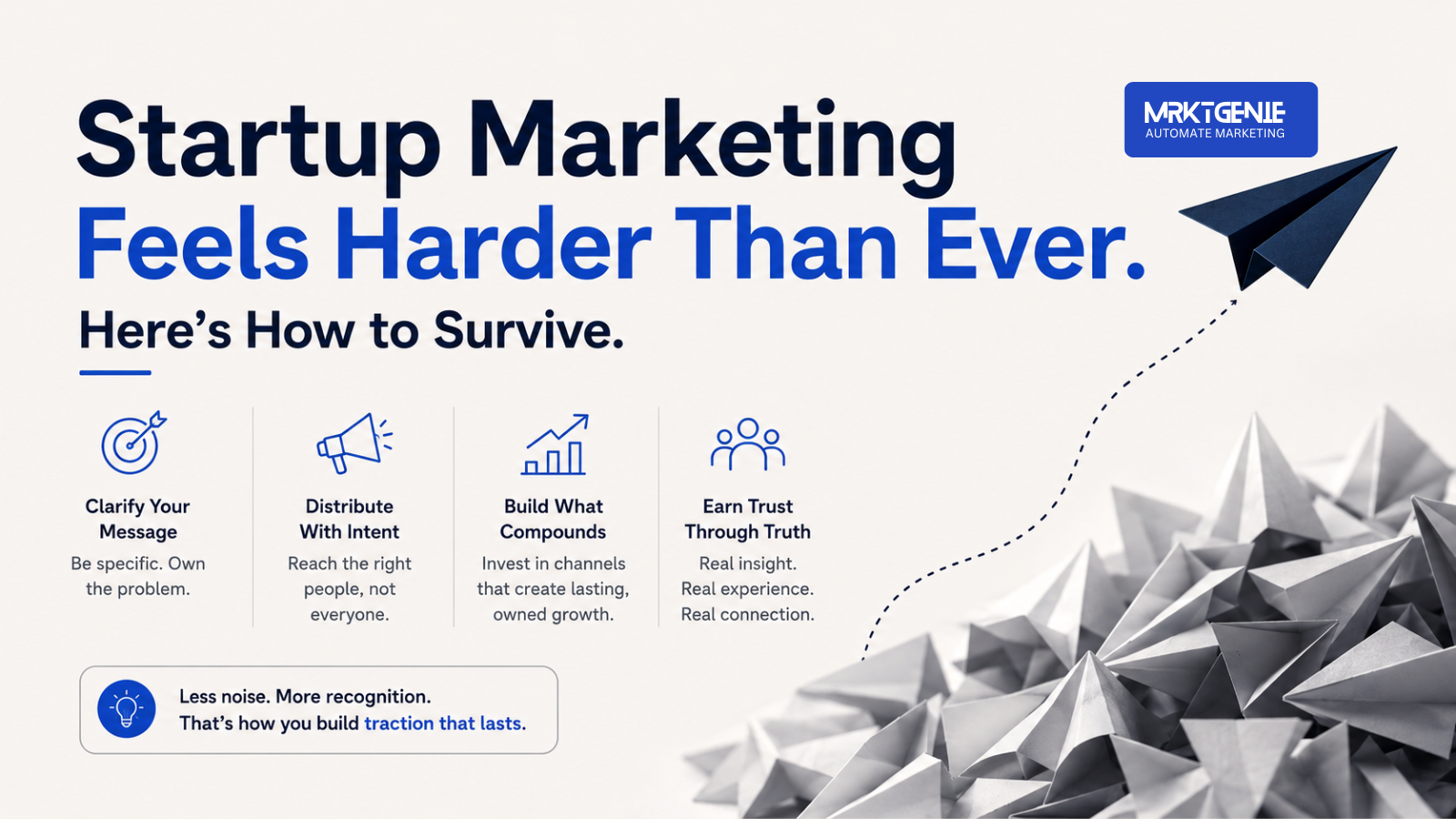
The startups that survive this era are not always the loudest. Often they are the ones that stay close to customer pain, build trust through specificity, diversify beyond rented platforms, and keep refining their message until the right people feel seen.
That is the bar now. Not more content. More recognition. Not more noise. More signal.
Startup marketing feels harder than ever because attention is scarcer, trust is pricier, and sameness is cheaper. But the upside is hidden inside the difficulty: if you can speak with real clarity in a market full of imitation, you do not need to outshout everyone. You just need to sound unmistakably true.